
The next Android : Android O

It’s been just about a year since Google unexpectedly announced the first preview of Android Nougat. Today, the company is launching the first developer preview of the next version of its mobile operating system, currently code-named Android O

The Developer Preview for Android’s latest version, O, is coming today — and a neat new feature is one previously available on just Android TV: picture-in-picture support.
The update will allow users to continue watching a video on a corner of the screen while simultaneously using another app. For example, you can continue watching YouTube while also watching where your Lyft driver is on a map without swapping between the two. The feature is similar Samsung’s multi-window support, but Android O will let users set their own aspect ratios, and you’ll get custom interaction buttons like play / pause to directly support video display. “Other new windowing features include a new app overlay window for apps to use instead of system alert window, and multi-display support for launching an activity on a remote display,” Google says.
Picture-in-picture is just one of the handful of new features that come with Android O today. Compatible devices for the preview include the Nexus 5X, Nexus 6P, Nexus Player, Pixel, Pixel XL, and Pixel C.
Notification channels
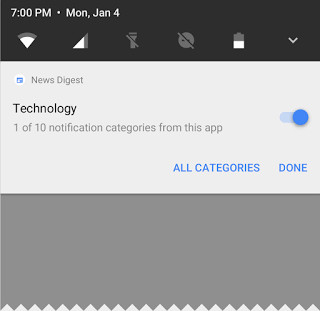
Android N brought a new framework for notifications and ways for developers to use it so we get more information in a space where real estate is at a premium.
With Android O Google is introducing new Notification channels: grouping notifications together by their type. Notifications are still managed by the app that delivers them, but users can control how things are displayed on a per-channel basis. This way we can decide things like how a news app notifies us or a music player shows a persistent notification. Notification channels is a new way for us to control the rich notifications that Android apps bring to us.
Picture in Picture: Android O video apps will be able to put themselves into a Picture in Picture mode so that video will still play after you switch to a different app (similar to what YouTube does when you press the back button while you watch a video).
Multi-display support: This one is interesting, and one of the many new features that seem aimed at both new kinds of devices and Android on Chrome OS. With this, developers will now be able to launch an activity on a remote display.
 Keyboard navigation: This, too, is essentially a feature for Android Apps on Chrome OS and will allow developers to better support arrow and tab navigation in their apps. “With the advent of Android Apps on Chrome OS and other large form factors, we’re seeing a resurgence of keyboard navigation use within Android apps,” Google says in today’s announcement.
Background limits: The last few Android releases put a heavy emphasis on improving battery life. Android O adds to this by putting automatic limits on what an app can do while they are in the background. These limits focus on three areas: implicit broadcasts, background services and location updates. For developers, this may actually be the most far-reaching of the new features in Android O and Google explicitly notes they should check out its documentation about these changes.
New Wi-Fi features: Wi-Fi may seem like an old hat, but Android O is adding support for a few (relatively) new connectivity features. The updated OS will support more Wi-Fi Aware features like Neighborhood Aware Networking (NAN), for example. NAN makes it easy for apps and devices to talk to each other without an internet access point in the middle (or any internet connectivity at all). Google says it is working with partners to bring support for NAN to devices “as soon as possible.”
Better interop for calling apps: Android O will make it easier for calling apps to talk to each other and make calls over the carrier network. Developers will now be able to use the new Telecom framework to build their own UI for placing calls and calls will be displayed and controllable via Bluetooth devices with displays like you’d find in a car. For the most part, this looks like a feature the telecoms will be happy about but that won’t matter all that much to users.
 There are obviously a few other new features and tweaks here, as well. Those include adaptive icons (similar to what you’ve seen on the Pixel), support for wide-gamut color capable displays, support for high-quality Bluetooth audio codecs (which may mean Google, too, is about to ditch the headphone jack on its own phones), a new native audio API, better font support and an improved WebView that has multi-process mode enabled by default.
Google also notes that Android O will support a number of new Java Language APIs and that the Android Runtime is now significantly faster, with some benchmarks seeing a 2x improvement.
For the most part, these updates aren’t earth-shattering, but it’s worth keeping in mind that this is a developer preview and we’ll likely see quite a few new features pop up before the public launch.
Like last year, Google promises it will do a deep dive on all things Android at its I/O developer conference in May. If the company follows the same release schedule as last year, we’ll likely see the first consumer devices with Android O at a Google hardware event in October.
Android Nougat two releases are currently installed on 2.8 percent of all Android devices and many users (more than 65 percent) are still using pre-6.0 releases. To some degree, it’s starting to feel as if Google is now developing Android for its own devices first, especially given that the first devices to launch with O(reo) pre-installed will likely be Google’s own again, too.
Will it be Android Oreo?
well we can't be sure about that.

Its been cupcake,donut,Eclair,Froyo,Gingerbread,Honeycomb,Ice cream Sandwich,Jelly bean,Kitkat,Lolipop,Nougat
will the next be Oreo ?

well ,the only thing we can do now is hope.And wait for the offical naming...


0 Comments